Do Cats Eat Rats Or Just Kill Them


Cats do both; they kill rats as part of their natural predatory behavior and may eat them, especially if fresh prey isn't readily available. While feral cats are more likely to consume rats due to limited food sources, domestic cats generally lean towards not eating them. Cats showcase their hunting instincts through calculated chases, captures, and playful interactions with rats. The dynamic between cats and rats provides mental stimulation and exercise for the feline hunters. Understanding cats' behavior towards rats sheds light on their predatory nature. Learn more about this fascinating interaction between two common urban critters.
Feline Predatory Behavior Towards Rats

Exhibiting instinctual predatory behavior, cats demonstrate a natural inclination towards stalking, pouncing on, and capturing rats as part of their innate hunting instincts. This behavior is not limited to domestic cats but also extends to feral cats that roam urban and rural environments.
Feral cats, having to fend for themselves, rely heavily on their hunting skills to secure food sources, which often include rats. Their adeptness at stalking and capturing rats showcases the deep-rooted hunting instincts that have been preserved through generations of cat evolution.
In urban areas, feral cats play a role in controlling rat populations by preying on them, thereby aiding in pest control. Understanding the predatory behavior of feral cats towards rats sheds light on the intricate relationship between predators and prey in the natural world.
Rat Consumption by Cats
Cats' hunting behavior of rats can lead to potential risks associated with rat consumption. While cats may eat a dead rat if necessary, they typically prefer fresh food and may avoid consuming rats they have killed.
Feral cats, when lacking other food sources, might resort to eating dead rats, showcasing the complexity of cat behavior in relation to rat consumption.
Cat Hunting Behavior
Cats occasionally consume rats they hunt, although their primary motivation for hunting these rodents often lies in instinctual predatory behavior rather than sustenance.
- Cats may view hunting rats as a form of play or exercise, tapping into their natural instincts.
- Their predatory behavior drives them to hunt rats even when not hungry, showcasing their hunting prowess.
- Cats may present their owners with dead rats as gifts or trophies, proudly displaying their hunting success.
- Domestic cats, preferring fresh food, may not consume the rats they hunt, unlike feral cats that may resort to consuming them due to limited food sources.
Rat Consumption Risks
Consuming wild rats poses potential health risks for domestic felines, including exposure to parasites, toxins, and diseases that can adversely affect their well-being.
| Health Risks of Rat Consumption for Cats | ||||
|---|---|---|---|---|
| Risk Factors | Description | Potential Harm | Prevention | Action Steps |
| Parasites | Intestinal worms | Sickness | Regular deworming | Vet consultation |
| Toxins | Poison | Illness | Avoiding ingestion | Immediate care |
| Diseases | Toxoplasmosis | Transmission | Litter box hygiene | Medical attention |
These risks highlight the importance of monitoring cat activities to prevent potential health issues associated with rat consumption.
Cat Vs. Rat Interaction Dynamics
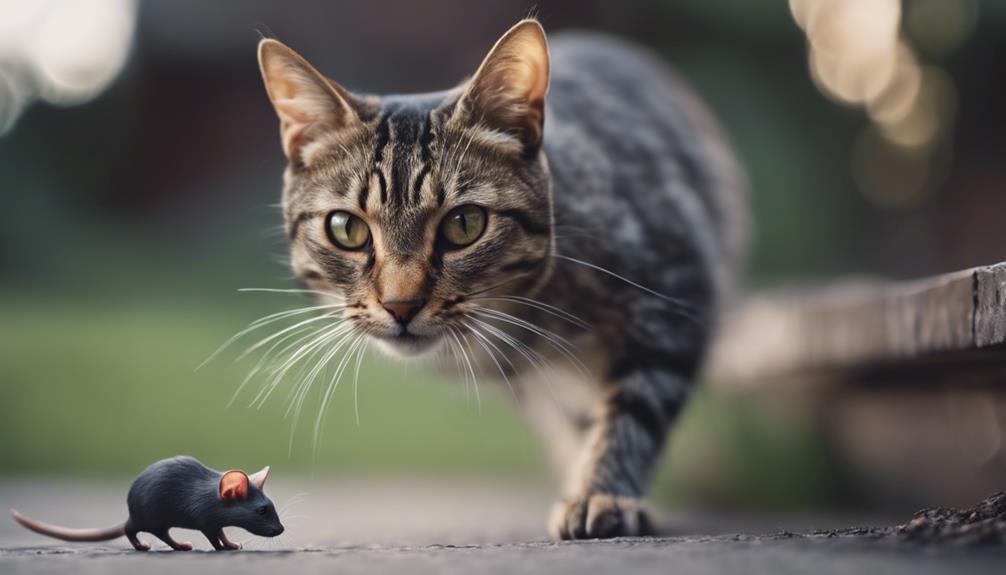
In the intricate dance of predator and prey, feline hunters engage with rats in a primal display of instinctual prowess.
- Cats use their keen senses of sight and hearing to detect rats.
- The chase between cat and rat can be intense and fast-paced.
- Cats often toy with rats before delivering a swift final blow.
- The cat's hunting instincts are honed through generations of evolution, making them efficient rat hunters.
Rat Control Methods With Cats
Utilizing feline hunting instincts for pest control purposes can effectively manage rodent populations in various settings. Cats, with their natural hunting abilities, can help in controlling rat infestations by targeting them as prey.
This method of rat control has been used in farms, warehouses, and even residential areas to keep rat numbers in check. While cats may not always eat the rats they catch, their mere presence and hunting behavior act as a deterrent for rodents.
Urban Cats and Rat Hunting
Cats living in urban environments exhibit varying hunting behaviors towards rats, impacting the effectiveness of using felines for rodent control in cities.
- Urban cats in cities like New York may prioritize easier prey sources over adult rats.
- Abundant food sources in urban areas can reduce cats' motivation to hunt rats.
- Research indicates that cats are more successful at catching mice than adult rats in urban settings.
- Municipal programs utilizing cats for rodent control may not effectively manage city rat populations.
Health Risks for Cats Eating Rats
When cats consume rats, they expose themselves to various health risks. These risks include the transmission of parasites and diseases from the rats to the cats.
Due to the importance of avoiding harm from ingesting rats, it's vital for cat owners to be aware of the health complications that can arise.
Cat Digestion of Rats
Cat digestion of rats poses significant health risks for felines, particularly due to the pathogens and parasites that rats may carry. When a cat consumes a rat, it exposes itself to various dangers such as:
- Contracting diseases like leptospirosis and toxoplasmosis.
- Intestinal parasites such as roundworms and tapeworms can be transmitted.
- Bacterial infections like salmonellosis and rat-bite fever are potential risks.
- Exposure to harmful chemicals that rats may have ingested, leading to poisoning.
These health risks highlight the importance of preventing cats from consuming rats to safeguard their well-being and prevent potential illnesses. It is essential for cat owners to be aware of these risks and take necessary precautions to protect their feline companions.
Cat Transmission of Diseases
Parasites and diseases can be transmitted to felines when they consume wild rats, posing significant health risks to their well-being. Rats can carry intestinal worms and toxins that are harmful to cats if ingested. This can lead to various health issues in cats due to potential pathogens present in the rats.
Of particular concern is toxoplasmosis, a disease that can be transmitted from cats to other animals, which is a risk associated with cat transmission of diseases through rat consumption. To mitigate these risks, regular deworming is recommended for outdoor cats that may hunt and eat rats.
Rat Consumption Impact on Cats

The impact of rat consumption on cats varies depending on their environmental circumstances and dietary preferences.
- Cats may eat a dead rat if hungry enough, but they usually do not consume what they kill themselves.
- Cats have a sensitive sense of smell and tend to avoid rotten rats for consumption.
- Feral cats may resort to consuming dead rats if no other food source is available.
- Domestic cats generally prefer fresh food over eating dead rats they encounter.
These points highlight how cats interact with rats they encounter, showing that their behavior towards consuming rats is influenced by various factors like hunger, freshness of the prey, and the availability of other food sources.
Cat Hunting Behavior Analysis
Cats exhibit instinctual hunting behaviors that involve both killing and consuming rats.
While hunting is a natural behavior for cats, the act of consuming the prey may not always follow the kill.
Cats may engage in hunting purely for the pleasure and mental stimulation it provides, regardless of their hunger levels.
Killing Vs. Consuming Rats
In the domain of feline hunting behavior, the act of killing rats by cats often transcends mere consumption, serving as a means to sharpen their predatory skills.
- Cats may view killing rats as a form of play, reflecting their natural instincts.
- The sight of a cat presenting a dead rat can evoke mixed emotions in owners.
- Some cats may leave the rats they kill uneaten, indicating their hunting prowess.
- Well-fed domestic cats may engage in rat hunting purely for sport rather than sustenance.
Instinctual Hunting Behaviors
Honing their predatory prowess through playful interactions and practical experiences with small mammals like rats, felines exhibit instinctual hunting behaviors essential to their well-being and satisfaction. Cats' natural drive to hunt is instilled from a young age, with mothers teaching kittens the necessary skills for successful hunting.
This innate behavior is vital for cats, as it fulfills their predatory instincts and provides mental stimulation. Prey presentation, where cats offer rats as gifts or trophies, showcases their hunting prowess and innate instincts. Understanding these instinctual behaviors not only enhances the bond between humans and cats but also allows for a deeper appreciation of feline nature.
Cats as Rat Predators

Exhibiting their innate predatory instincts, felines are adept rat predators in various environments.
- Cats stalk rats with precision, utilizing their keen senses to locate and ambush their prey.
- The chase is exhilarating for cats, showcasing their agility and speed in capturing rats.
- The moment of capture is intense, as cats swiftly immobilize rats with calculated strikes.
- After the successful hunt, cats may proudly display their conquest, demonstrating their hunting prowess.
Will Cats Eat Squirrels Like They Eat Rats, Or Do They Just Kill Them?
In the world of cats eating squirrels in NLP, it’s important to note that while cats may have the instinct to hunt and catch squirrels, they may not always eat them like they do with rats. Some cats may kill squirrels for fun or instinct, but not necessarily consume them.
Cat Rat Interaction Effects
Within the domain of feline behavior, the interaction between cats and rats yields various effects worth exploring. Hunting plays an important role in this interaction, as cats' innate predatory instincts drive them to hunt rats. While cats may not always consume the rats they catch, the act of hunting provides mental stimulation and exercise.
Additionally, cats' hunting behavior towards rats can help manage rodent populations in different environments. For cats, killing rats serves as a form of play and showcases their natural hunting prowess. This interaction exhibits how cats' predatory instincts are deeply ingrained, and their ability to catch and kill rats demonstrates their hunting skills.
Understanding these effects sheds light on the complex relationship between cats and rats in various settings.