
Cats can see clearly up to about 20 feet, but beyond that, objects appear blurry due to their nearsightedness. Their vision is optimized for close-range interactions, affecting their ability to focus on distant objects sharply. Cats rely on smell and hearing to compensate for their limited long-distance vision. Enhanced night vision makes them adept hunters in dim light, seeing up to six times better than humans. Cats have a narrow field of vision, but their peripheral vision is wider than humans', aiding in vigilance. Whiskers contribute to their visual acuity and spatial awareness. Understanding more about cats' vision can shed light on their fascinating abilities.
Cats' Limited Long-Distance Vision

With a visual acuity optimized for close-range interactions, cats exhibit limitations in their long-distance vision. Cats can see clearly up to about 20 feet, beyond which objects start becoming blurry.
Due to their nearsightedness, cats have challenges in seeing distant objects sharply. Their vision is tailored for hunting and stalking prey up close, relying on other senses like smell and hearing to compensate for their limited long-distance vision.
Cats' Superior Low-Light Vision
Cats possess enhanced night vision due to having more rod cells in their eyes, enabling them to see up to six times better than humans in low light conditions.
Their pupils can dilate wider than humans', allowing more light to enter, further enhancing their ability to see in the dark.
Cats' superior light sensitivity and pupil adaptation ability make them adept hunters in dim lighting environments like dusk and dawn.
Enhanced Night Vision
How do cats possess such superior low-light vision compared to humans?
Cats' enhanced night vision stems from having more rod cells in their eyes, enabling them to see up to six times better in low-light conditions. Additionally, the tapetum lucidum, a reflective layer behind their retinas, boosts their night vision by reflecting light.
This superior night vision is essential for cats' hunting prowess and predatory behaviors in dimly lit environments.
Pupil Adaptation Ability
Cats' exceptional ability to rapidly expand their pupils enables them to maximize light intake, enhancing their vision in low-light conditions. Their large pupils aid in quick pupil adaptation to changes in light intensity, improving night vision.
Superior Light Sensitivity
With unparalleled light sensitivity, felines possess an exceptional ability to navigate and thrive in dimly lit environments, showcasing their superior low-light vision. Cats' eyes contain a high number of rod receptors, enabling them to see clearly in low light.
The tapetum, a reflective layer behind their retinas, enhances their vision in dim conditions. This vision optimization makes cats well-suited for hunting at dawn and dusk, where light levels are minimal.
Cats' Narrow Field of Vision
Cats possess a narrow field of vision, limiting their ability to see clearly beyond approximately 20 feet. This nearsightedness affects their capacity to focus on distant objects, making it challenging for them to discern details over longer distances.
Despite this limitation, cats compensate for their restricted distance vision with heightened senses of smell and hearing, which aid in their hunting and survival.
Cat's Peripheral Vision
A distinguishing trait of feline vision is their wider peripheral range, encompassing approximately 30 degrees, surpassing the 20-degree span of human peripheral vision. This wider field allows cats to stay vigilant, detecting approaching objects and potential threats from the side.
Understanding their peripheral vision sheds light on their alertness and awareness, essential for monitoring their environment and ensuring quick responses to any perceived dangers.
Depth Perception in Cats
Moving about their surroundings with caution, feline companions possess a limited field of vision that hinders their ability to perceive objects clearly beyond a distance of 20 feet. Due to being nearsighted, cats struggle with focusing on distant objects, leading to blurred vision.
Their visual acuity ranges from 20/100 to 20/200, emphasizing the challenges they face in seeing distant objects with clarity, relying on other senses and instincts to compensate.
Cats' Whiskers Help With Sight
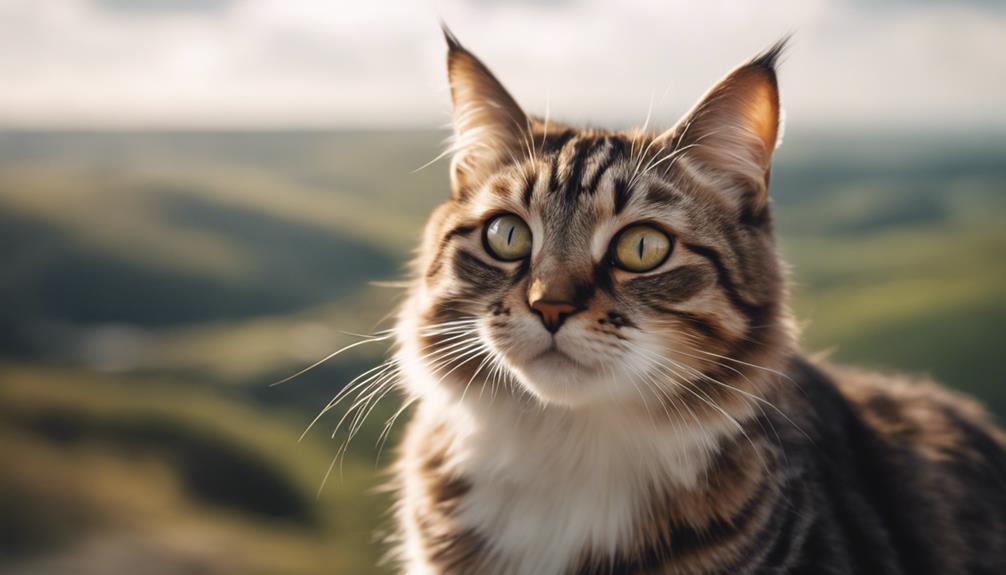
Strategically positioned around a cat's face, whiskers serve as essential sensory tools that greatly contribute to their visual acuity and spatial awareness.
These whiskers are vital for their close-range vision, providing tactile information about objects and distances.
Cats rely on whiskers to compensate for their limited ability to focus on nearby objects, aiding in judging distances accurately and interacting effectively with their environment.
Cats' Color Vision Differences
Cats possess a unique color vision system that differs markedly from that of humans. They are red/green color blind, perceiving these colors as shades of grey due to fewer cone cells in their eyes.
Cats see blue and yellow shades more vividly and rely on brightness over color for their vision. Their color vision is limited, making red and green appear similar to them compared to humans.
Cats' Enhanced Peripheral Vision
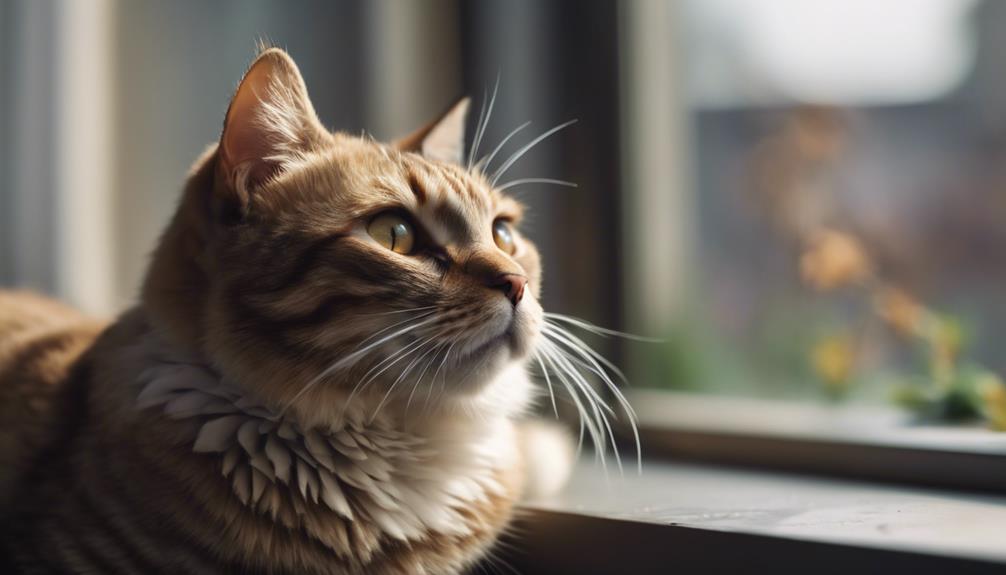
Cat's exceptional peripheral vision, spanning approximately 200 degrees, surpasses that of humans by 20 degrees, enhancing their ability to detect movement and potential threats from all angles. This wider field of view aids in maintaining awareness of surroundings, helping cats detect approaching objects.
Understanding their peripheral vision is key to interpreting their visual perspective, behavior, hunting techniques, and stalking prey effectively.
Cats' Ability to Track Moving Objects
With their highly sensitive eyes, cats possess a remarkable ability to track moving objects with exceptional precision. This skill is rooted in their specialized vision, honed by hunting instincts.
Cats' acute sensitivity to movement allows them to follow fast-moving objects, essential for behaviors like stalking and pouncing. Their capacity to react swiftly to changes in their surroundings showcases their remarkable tracking abilities in the animal kingdom.
Cats' Reliance on Other Senses
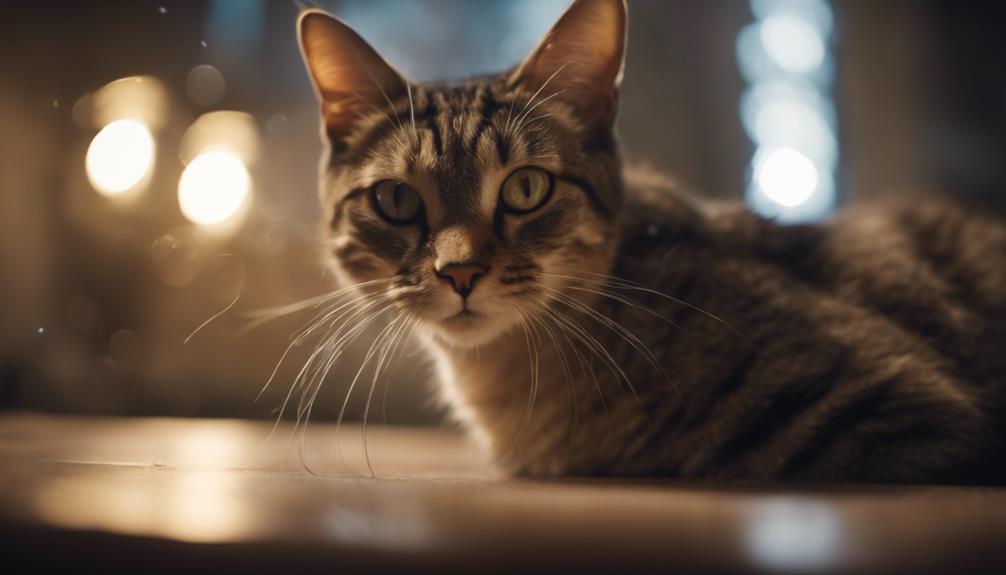
In addition to their exceptional visual tracking abilities, cats heavily rely on their acute sense of smell, hearing, whisker sensitivity, and touch to navigate their surroundings and interact with the world around them.
Cats use whiskers to help see close objects, hear to make sure of their surroundings, and touch for exploration. These senses also aid cats in seeing in the dark or dim light conditions when they can't see clearly.
Can a Cat’s Vision Help Them Roam Far Distances?
Yes, a cat’s vision plays a crucial role in their ability to roam far distances. This is especially true for feral cats’ roaming distance, allowing them to navigate various terrains and find food sources. Their keen eyesight enables them to hunt and explore new areas, contributing to their survival in the wild.
Cats' Tapetum Lucidum and Vision
Enhancing their night vision greatly, cats possess a unique anatomical feature known as the tapetum lucidum, which plays an essential role in their exceptional visual capabilities.
- The tapetum lucidum is a reflective layer behind cats' retinas that enhances their night vision by reflecting light.
- This reflective layer helps cats see in light levels six times lower than what a human needs to see.
- The tapetum lucidum aids in gathering more light for the photoreceptors in cats' eyes.
- Cats' tapetum lucidum is responsible for their ability to see in the dark and hunt effectively during low light conditions.