
Quick Answer
Introduce two cats with separation first, scent second, sight third, and supervised meetings last — never by letting them "sort it out" face to face. Keep the new cat in one prepared room for the first days. Feed both cats on opposite sides of the closed door, swap their bedding so each learns the other's smell, then allow short visual sessions, and only then open the door for brief supervised contact. Most calm introductions take one to three weeks. Hissing at a door is normal and informative; a full-blown fight is a signal to slow down, not to give up.
- The new cat gets its own room with food, water, litter, bed, and hiding spots.
- Every meeting happens at a distance the calmer cat controls.
- End every session before either cat gets stressed — short and sweet wins.
Why Slow Wins
Cats are not pack animals. In nature they are solitary hunters who defend territory, and while domestic cats can form deep friendships, friendship is something they choose after the territory question is settled — not before. A rushed introduction skips the negotiation phase and lands two cats in a corner where their only available behavior is defense. International Cat Care's guidance is to introduce cats safely and gradually precisely because a bad first meeting is hard to undo: fear and hostility learned at the first encounter can take months to unlearn (iCatCare: Introducing Cats).
The good news: cats have a natural negotiation protocol, and you can run it for them. Smell carries most of the conversation. A cat who has smelled the newcomer through a door for a week is not meeting a stranger on day seven — they are meeting someone whose scent file is already complete. The Ohio State University Indoor Pet Initiative frames the same idea around reducing stress: new pets must be introduced slowly and carefully so the resident cat never feels its territory is being invaded all at once (OSU Indoor Pet Initiative: New Pets).
Before the New Cat Arrives
Prepare one room before pickup day: door that closes, food and water bowls, a litter box (see litter box setup for placement rules), a bed, toys, and at least one hiding spot like an open cardboard box. The room should be the one place the new cat owns outright for the first week. If you are adopting, our first 72 hours guide covers the full arrival plan, and what helps a hiding cat explains why under-bed campers are normal.
Also prep the resident cat's side: keep its routine absolutely unchanged — same feeding times, same attention schedule — so the arrival of a stranger does not read as the start of resource scarcity. If the resident cat is shy or anxious, consider whether this is the right season for an addition at all.
Step-by-Step Introduction Plan
- Full separation (days 1-3 minimum). The new cat stays in its room. No visual contact. This is decompression time, not introduction time. Visit the room often, keep the resident cat's routine untouched, and let both cats eat and sleep normally.
- Scent exchange (days 2-5). Swap bedding, blankets, or towels between the two spaces daily. Rub a clean cloth on each cat's cheeks and leave it in the other's room. Feed both cats on opposite sides of the closed door — the door becomes the dinner table where the smell of the other cat predicts good things.
- Visual contact at a distance (days 4-7). Crack the door a few centimeters, or use a baby gate, with the new cat's room as the safe retreat behind it. Keep sessions to a few minutes and pair them with treats or play. Hissing, growling, or staring is the cats saying "too close" — close the gap less next time, or go back to full separation for a day.
- Short supervised meetings (week two). Open the door fully when both cats are relaxed, and stay in the room. Let the new cat choose whether to come out. Have treats and a wand toy ready to redirect tension, and separate them at the first hard stare, raised fur, or growl — end the session before it becomes a fight.
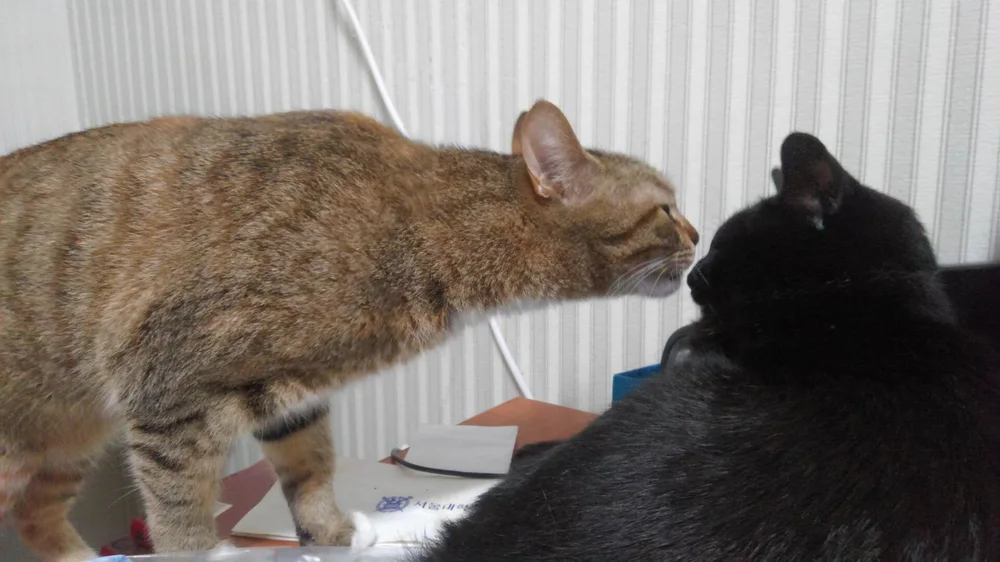
Photo: salamander724 / Wikimedia Commons (Public domain) - Gradually longer shared time (week two to three). Extend supervised time as sessions stay calm. Feed them in the same room at a comfortable distance, then slowly bring the bowls closer over several days. Never leave them unsupervised together until you have seen many calm sessions in a row — and even then, a camera for the first few nights is cheap insurance.
Watch body language at every step: slow blinks, turned-away faces, and play bows are green lights; flattened ears, puffed tails, and direct stares are yellow ones. Our guide to cat body language helps you read the difference.
The whole plan on one timeline — most calm introductions land between one and three weeks, and every phase is gated on the previous one staying calm:
| Phase | Typical timing | What happens | Advance when… |
|---|---|---|---|
| Full separation | Days 1–3 | New cat owns one room; no visual contact | Both cats eat and sleep normally |
| Scent exchange | Days 2–5 | Swap bedding daily; feed at opposite sides of the closed door | Both cats eat calmly at the door |
| Visual contact | Days 4–7 | Crack the door or use a baby gate; short sessions with treats | No hissing or hard staring for a few sessions |
| Supervised meetings | Week two | Door open, you stay in the room; treats and wand toy ready | Several calm sessions in a row |
| Shared time | Weeks two–three | Longer supervised time; bowls slowly closer | Many calm sessions; then camera for first nights |
A Practical Example
When a tabby named Juniper came home to a household with a seven-year-old resident cat, her people followed the door-and-scent script to the letter. Juniper spent four days in the guest room. Day three, both cats ate calmly at their own sides of the closed door. Day five, a crack of the door produced one hiss from the resident and immediate retreat on both sides — so they closed it again and swapped bedding for two more days.
Day eight, supervised meetings started at ten minutes with the resident's favorite treats as the soundtrack. By day twelve the cats were napping on opposite ends of the same sofa; by week three they were grooming each other. The total hiss count was one. Compare that with the neighbor's experience — an instant "let them meet" introduction that produced a fight, a vet bill for a scratched eye, and two cats who still cannot share a room six months later. Slow is not cautious for its own sake; slow is the fast version that works.
Small Tips That Make This Easier
Run the introduction during a quiet stretch of your life — not the week of a house move or a big work deadline. You are the referee, and referees need to be present.
More litter boxes and feeding stations than cats, in separate locations, prevent resource tension from undoing your progress. See multi-cat feeding for the bowl layout, and the litter box planner for box placement.
Give the resident cat extra attention, not less, during the introduction — jealousy is a human word for a real cat phenomenon: the cat whose routine changes most is the one most likely to act out.
If either cat is very shy, use the indoor enrichment planner to add calm activities (puzzle feeders, vertical space) to both rooms — busy, confident cats negotiate better than bored ones.
Common Mistakes
- Letting them "work it out." Cats do not resolve first meetings through a fight and then become friends; they resolve them by one cat claiming the territory and the other living in fear.
- Holding one cat to force a meeting. A restrained cat is a terrified cat, and the other cat reads that terror as a threat.
- Punishing hissing or growling. Those sounds are communication, not misbehavior. Punish them and the cats learn to skip the warning phase — straight to swatting.
- Rushing because "they seem fine." Calm is fragile in week one. Keep supervision until many relaxed sessions prove the pattern.
- Giving up after one fight. A fight means you moved too fast, not that the cats are incompatible. Return to full separation and restart the scent phase; many eventual friendships include one early skirmish.
- Adding more cats mid-introduction. Every new cat resets the territorial math for everyone already in the house.
Reading the signals correctly is the difference between a calm introduction and a fight you could have prevented:
| Signal | Meaning | Your move |
|---|---|---|
| Slow blinks, turned-away face | Green light — relaxed, no threat | Keep the session going |
| Play bow, tail up, soft chirp | Green light — friendly interest | Encourage with treats and play |
| Flattened ears, direct stare | Yellow light — tension building | Increase distance or end the session |
| Puffed tail, arched back, growl | Red light — defensive posture | Separate now; go back a phase tomorrow |
| Hissing at the door | Normal — communication, not failure | Keep the door closed; it usually fades in days |
When to Call a Vet
Separate the cats and call a veterinarian if a fight produces a wound, lameness, or swelling — cat bites abscess quickly and are easily hidden under fur. Also call if either cat stops eating for more than about 24 hours, stops using the litter box, or hides and refuses to move during the introduction; stress can unmask illness in cats. If introductions have stalled for weeks with repeated fighting, ask your vet about a veterinary behaviorist before deciding the cats cannot coexist. Cat Cafe Central is educational and cannot diagnose your cat.
Trusted Sources
Related Guides and Tools
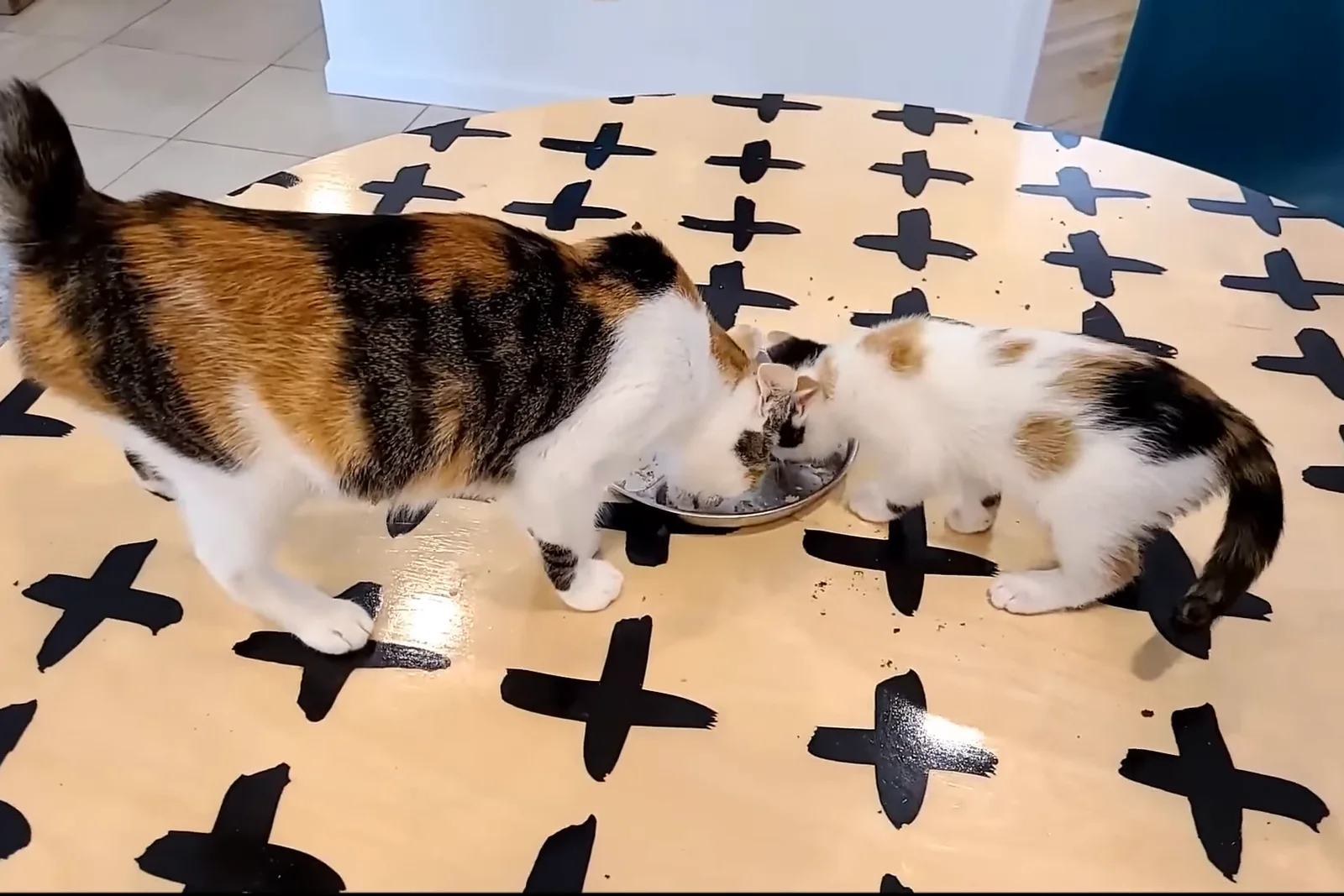
How to Manage Multi-Cat Feeding Without Mealtime Tension
Plan calmer multi-cat meals with separated stations, measured portions, observation, and individual needs.

How to Set Up a Cat-Friendly Home Without Overcomplicating It
Create a cat-friendly home with separated resources, vertical space, scratching options, quiet retreats, and predictable routines.

Understanding Cat Body Language: Ears, Tail, Eyes, and Distance
Learn how to read common cat body language signals so you can respond with less pressure and more trust.
Related glossary: Scent Swapping, Resource Guarding, Territory.