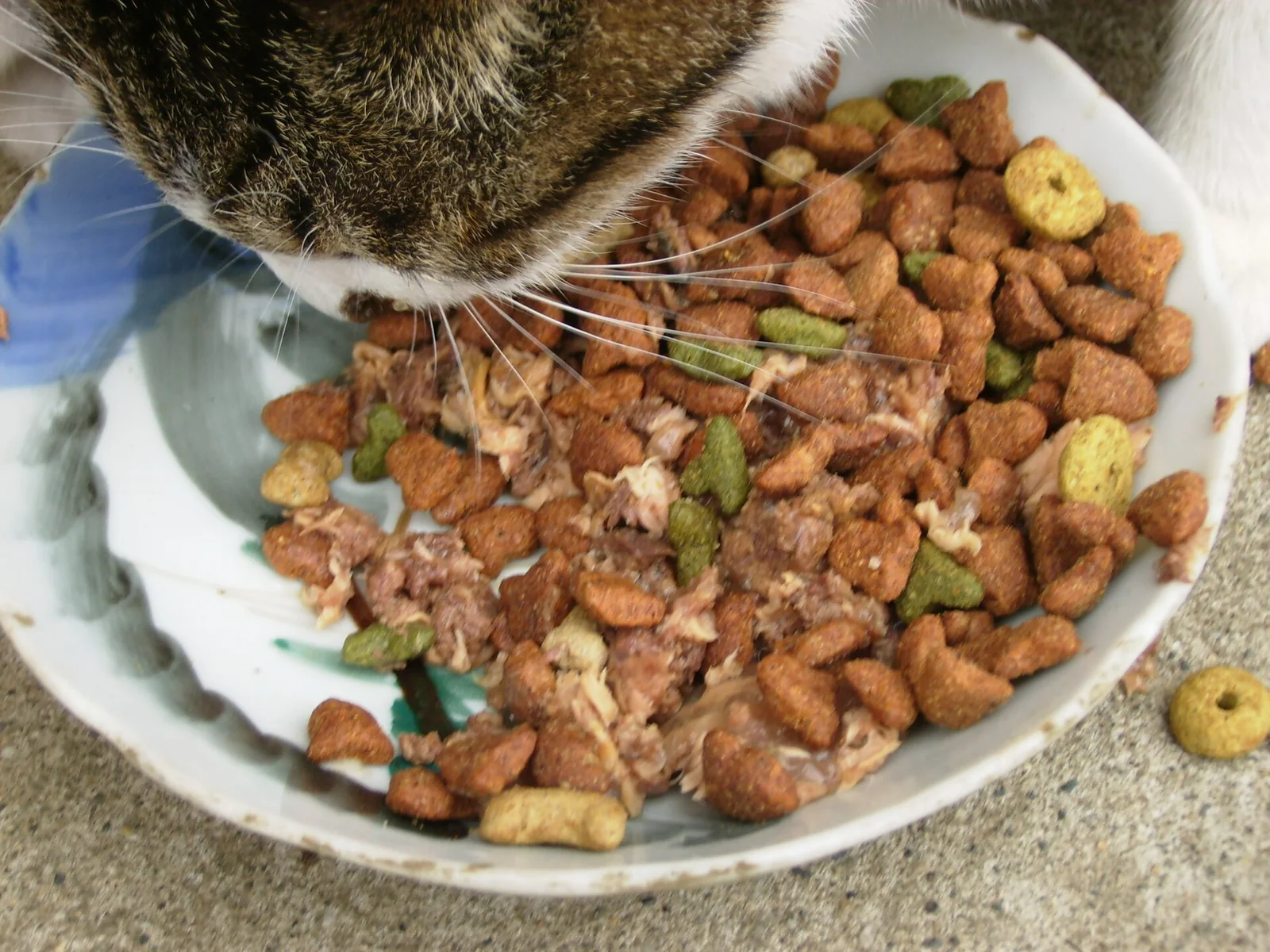
Quick Answer
Change cat food over at least 7 to 14 days — longer if your cat is picky or has a sensitive stomach. Offer the old and new food in separate bowls, starting at roughly 75% old and 25% new, and shift the ratio every few days. Never force a change by starving the cat into it: cats that stop eating can develop serious liver problems quickly. If your cat refuses the new food for more than about 24 hours, or shows vomiting, diarrhea, or appetite loss during the transition, slow down and talk to your vet.
- Two bowls side by side beat mixing two foods in one bowl for most cats.
- Seven days is the fast end of normal; some cats take two to eight weeks.
- Change one thing at a time — never food, bowl, schedule, and location all at once.
Why a Gradual Change Matters
A cat's digestive system runs on routine. A sudden switch to a new food changes the fat, protein, and fiber profile overnight, and the gut reacts the way any gut reacts to surprise: vomiting, diarrhea, or both. International Cat Care's advice is straightforward — change gradually to avoid gastrointestinal upset, and expect some cats to take 5-7 days while others need two to eight weeks (iCatCare: How to change your cat's food to a new diet).
The other half of the equation is taste, and cats are famously fixed in their preferences. Their likes are shaped early, and texture matters as much as flavor — a cat who only knows dry kibble may genuinely not recognize wet food as food on day one. That is not stubbornness; it is a cat being a cat. The transition period is where you teach the new food to smell and feel familiar, and rushing it teaches the opposite lesson.
There is also a real danger zone on the far end: a cat who refuses food entirely can develop hepatic lipidosis — a potentially life-threatening liver condition — faster than most owners expect. Cornell notes that finicky cats and any cat refusing food while losing weight need a veterinary exam rather than a waiting game (Cornell: Feeding Your Cat). That is why "she will eat when she is hungry enough" is the one piece of old advice this guide explicitly rejects.
Before You Start: Pick the Right New Food
Check that the new food carries a complete and balanced statement — the AAFCO nutritional guarantee on the label — matched to your cat's life stage. Cornell points out that the AAFCO statement is the baseline for nutritionally complete food, and that ingredients are listed by weight, so animal-source proteins near the top of the list are a good sign (Cornell: Feeding Your Cat). If the change is for a medical reason — prescription diet, kidney support, weight management — let your vet name the product and the timeline; medical transitions sometimes skip the slow route on purpose, under supervision.
Buy the new food before the old bag runs out, and check the expiration date: Cornell warns that stale or poorly stored dry food loses nutrient potency and can turn rancid, which is a great way to make a cat conclude that all new food is suspicious (Cornell: Feeding Your Cat). Store dry food in an airtight container. If you are not sure where to start on food basics, our beginner's guide to what to feed a cat covers the label-reading groundwork.
Step-by-Step Transition Plan
- Serve the two foods in separate bowls. International Cat Care notes that most cats dislike two foods mixed into one bowl, so offer the old and new side by side and let the cat choose the mix ratio by eating (iCatCare: How to change your cat's food). Remove whatever is uneaten after 20-30 minutes if you are on scheduled meals.
- Start at roughly 75% old, 25% new. Keep that ratio for two to three days. Watch the litter box: normal poop means the gut is coping.
- Move to 50/50 for a few days. If your cat eats both bowls happily, keep stepping. If the new bowl keeps getting ignored, hold at the current ratio instead of pushing forward.
- Step to 25% old, 75% new, then all new. Each step is two to three days at minimum. A full, gentle transition usually lands between one and two weeks; pickier cats legitimately take longer, and slow is fine.
- If your cat refuses the new food entirely, do not escalate. Go back a step, try warming wet food slightly (cats prefer food near body temperature), or offer a taste of the new food as a treat after play. Some cats accept a new diet faster when the new food arrives as a reward rather than a replacement (iCatCare: How to change your cat's food).
- Handle texture changes separately. Moving from dry to wet (or the reverse) is a bigger leap than brand to brand. Expect a longer timeline, and consider a middle step like adding warm water to kibble to soften texture gradually.
Kittens under one year need age-appropriate food and a gentler hand — see kitten care basics for the first-year feeding plan, and if the change is happening alongside a new home or new pet, see helping a new cat settle in — never stack a food change on top of a stress event if you can avoid it.
A Practical Example
Milo, a seven-year-old on a standard adult kibble, needed to move to a senior formula. His owner tried the classic shortcut — one bowl, new food only — and Milo responded by not eating for a day and a half. Understandably nervous, she called the vet, then restarted properly: separate bowls, 75/25 for three days, 50/50 for four, and a full week at 25/75 because Milo dawdled at that step. Total time: about two and a half weeks, with zero vomiting and zero missed meals.
The detail that made it work was watching the litter box, not the bowl. Firm normal stools were her signal to step up; the one soft day she saw early on sent her back a step instead of forward. The transition finished with Milo eating the senior food from the old bowl, in the old spot, at the old time — every familiar thing stayed constant while only the food changed.
Small Tips That Make This Easier
Keep the old routine sacred: same bowls, same place, same times. A food change is enough novelty for one week.
Scheduled meals make transitions measurable. If you free-feed, you cannot tell who ate what or how much — switch to timed meals during the transition weeks. Our multi-cat feeding guide covers how to run this when more than one cat shares the kitchen.
Weigh your cat at the start and end of the transition. Two weeks is long enough for a real weight change to show, and the scale does not lie about whether the new food is being eaten.
If your cat is a grazer and the new food is wet, expect a learning curve — wet food cannot sit out all day. Many owners transition wet-food cats to two or three timed meals; the cat feeding estimator helps you portion the day correctly.
Common Mistakes
- The overnight switch. The fastest route to a week of diarrhea and a cat who now distrusts the food bowl entirely.
- "She will eat when she's hungry enough." Food refusal in cats is not a hunger strike to be won — it is a medical risk to be managed. Never withhold food to force acceptance.
- Mixing both foods into one bowl. Many cats will pick around the new food and eat less overall; separate bowls let the cat set the pace.
- Changing everything at once. New food plus new bowls plus a new feeding spot plus a new schedule is four changes wearing one cat costume.
- Rushing because the old bag is empty. Buy the new food a week before you need it. Transitions that start from an empty pantry start with panic.
- Ignoring the litter box. Soft stool, diarrhea, or constipation during a transition is the signal to slow down, not to push through.
When to Call a Vet
Call a veterinarian if your cat refuses food for more than about 24 hours, loses weight during a transition, vomits repeatedly, or develops diarrhea that lasts beyond a day — and sooner if your cat is overweight, since rapid food refusal is riskier in heavier cats. Sudden appetite loss is always worth a call even outside a food change: see what to check when a cat is not eating for the full list of red flags. Cat Cafe Central is educational and cannot diagnose your cat.
Trusted Sources
Related Guides and Tools
What to Feed a Cat: A Beginner's Guide to Meals, Water, and Treats
A beginner-friendly overview of complete cat food, wet versus dry food, treats, water placement, and food changes.
Cat Not Eating: What to Check and When to Call the Vet
A calm appetite checklist for cats who skip food, including food changes, stress, nausea signs, and urgent veterinary boundaries.
How to Manage Multi-Cat Feeding Without Mealtime Tension
Plan calmer multi-cat meals with separated stations, measured portions, observation, and individual needs.
Related glossary: Food Transition, Complete And Balanced, Palatability.